

01
Connect yourApp Store account
Bring your own App Store Connect key. Spek uses the official token API, so no Apple ID password or login is handed over.
Spek preview in front. Select the other card or its product name to bring it forward.
Spek helps over 500 apps grow. Across every stage of growth.
| Features | Spek | Sensor Tower |
|---|---|---|
| Agentic ASO with a proposal review inbox | Available | Not available |
| Agent proposals applied to Editor drafts | Available | Not available |
| ASO workflow | Available | Available |
| App Store keyword research | Available | Available |
| Keyword rank tracking | Available | Available |
| Competitor keyword insights | Available | Available |
| Multi-market keyword research | Available | Available |
| Historical keyword rankings | Available | Available |
| Keyword search demand estimates | Available | Available |
| Keyword difficulty analysis | Available | Available |
| Keyword opportunity scoring | Available | Available |
| Keyword-level download estimates | Not available | Available |
“With Spek, we can turn keyword opportunities into listing updates in one place, with our team in control of what goes live.”

01
Bring your own App Store Connect key. Spek uses the official token API, so no Apple ID password or login is handed over.
02
The agent researches each market in its own language and drafts the changes with the visibility lift it expects.
03
Push the changes you accepted straight to the App Store or Google Play, in each market and language you selected.
Let Spek research opportunities and prepare listing changes for you to review.
Find keywords for your app across the App Store and Google Play.
Adapt your listing for each market with localized drafts you can review and edit.
Follow daily keyword positions and see how your search visibility changes over time.
See which apps compete for your keywords and compare their search visibility.
Accept the changes you want, then publish your approved update when you’re ready.
If you’re comparing Spek and Sensor Tower for App Store and Google Play growth, you probably have a specific job in mind. You might want to find better keywords, understand a competitor’s position, or finally turn a backlog of ASO research into listing updates.
Both products can help with keyword research and competitor insights. Where they differ is in the work they bring together. Spek connects research with an ASO agent, localized proposals and a review workflow. Sensor Tower puts ASO alongside broader intelligence about app performance and the mobile market.
That distinction matters once you start using either tool. A team preparing its next release has different needs from an analyst investigating a new category. And a growing studio may need help with both.
This comparison looks at the work behind those decisions: finding opportunities, writing for different markets, reviewing changes and understanding what happened afterward. Start with the part of ASO that takes your team the most effort.
Start a research run and receive proposed listing changes your team can inspect and act on.
Review suggested wording for your selected markets, with keyword opportunities and listing copy in the same workflow.
Accept or reject proposals, then refine accepted changes in the Editor before publishing.
Ask questions about your app and work through your next changes in conversation.
Follow tracked keyword rankings and compare competitor visibility across your target markets.
Discover keywords, organize lists, compare competitors and track performance through ASO Keywords.
Assess terms using rankings, traffic, difficulty, opportunity and keyword download estimates.
Use the wider App Performance Insights offering to investigate estimated downloads, revenue, engagement and category trends.
Our view: Spek is a strong fit when your team needs help getting from an opportunity to a reviewed update. Sensor Tower deserves a closer look when ASO is one part of a broader market research role. The sections below explain how to evaluate that fit in practice.
Finding a promising keyword is the beginning of the work. Someone still needs to decide whether it describes the app accurately, where it belongs in the listing and which existing wording should change.
Sensor Tower’s ASO Keywords supports discovery, keyword management, competitor analysis and performance tracking. You can organize terms into topic lists, investigate gaps in competitor coverage and compare how keywords perform over time. That structure gives an ASO specialist several ways to explore a search opportunity.
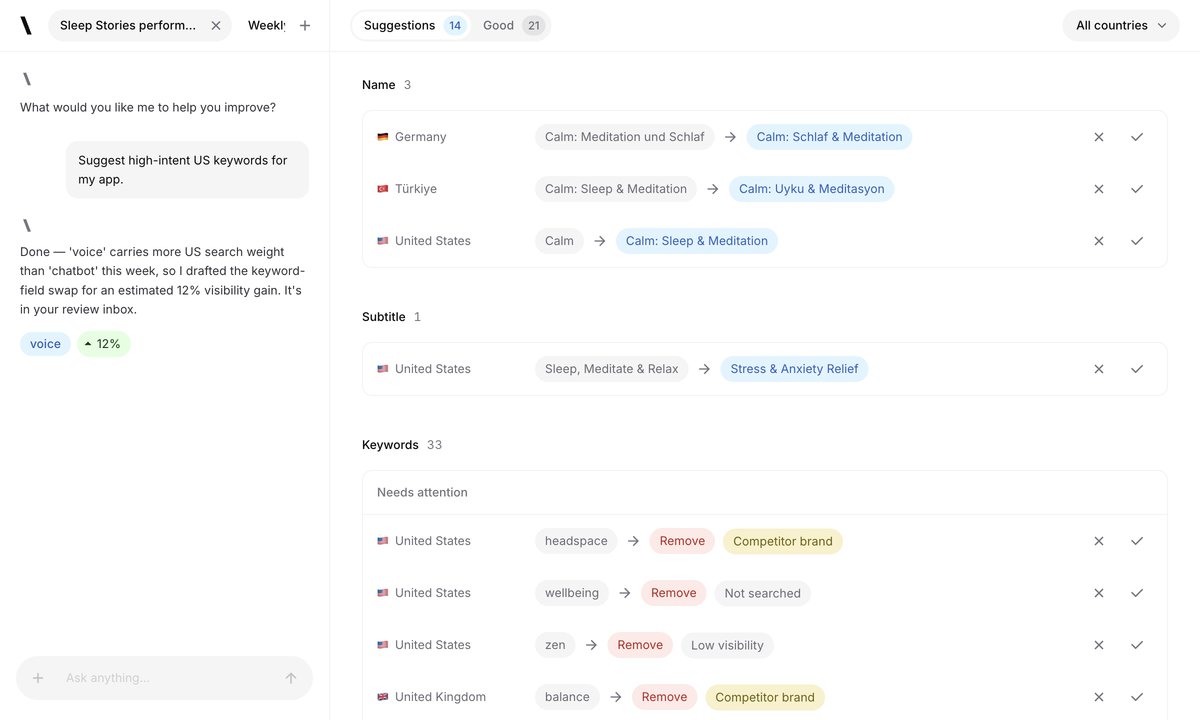
Spek carries the research into proposed changes for your app. You select markets and relevant competitors, start an Agent run and review the suggestions it prepares. For an App Store listing, these can include changes to the name, subtitle and keyword field.
Imagine your sleep app has an opportunity around bedtime stories. You need to decide whether the phrase fits your offering and how to describe it naturally. A proposed subtitle gives you something concrete to assess: the wording, its relevance and what you would change before using it.
When you compare the tools, take one opportunity all the way to a draft. Notice how much interpretation, writing and copying between tools your team still needs to do. That is a more useful test than comparing the length of two keyword lists.
AI is useful when it takes a meaningful part of the work off your hands. For app teams, that often means preparing a first draft, explaining a suggestion or helping turn a research finding into a decision.
Spek’s Agent prepares proposals in an inbox where you can inspect the suggested changes. Agent chat gives you a place to ask follow-up questions and discuss the work in the context of your app. Accepted proposals move into editable drafts, so the output has a clear next step.
When evaluating this workflow, look at three things:
Does the proposed copy describe features your app actually offers and use language your audience would recognize?
Can you understand the suggestion and decide what to keep without reconstructing the research yourself?
How much editing remains before your team is comfortable using the draft?
Your team still brings the product knowledge and editorial judgment. The value of the Agent is in the quality of the work it prepares for that review. Judge it with an app you know well enough to spot both a useful suggestion and a poor one.
Expanding into another market adds research, writing and review work. A direct translation may describe your product correctly while missing the language people use to search for it. Your local reviewer needs to consider both.
Sensor Tower includes keyword localization in its ASO toolkit, alongside research into competitors’ store strategies. Spek brings localized proposals into the review workflow for the markets you select, giving your team suggested wording to work with.
For example, a team preparing French and German listings needs to check more than whether the English message survived translation. Does the wording sound natural? Does it match the features available in that market? Can someone who knows the language make the final edits without losing track of the proposed changes?
Evaluate a market you already understand alongside one you want to develop. The familiar market helps you judge the suggestions; the newer one shows how much research and editorial support your expansion will need.
A listing is a promise to the people considering your app. Your team needs to check that every change reflects the product, respects the brand and is ready for the store.
In Spek, an Agent proposal goes through distinct steps. You review it, accept the changes you want and refine the draft in the Editor. Publishing requires an explicit action from an authorized team member. Accepting a suggestion does not publish it.
For App Store updates, publishing also depends on the listing’s current state in App Store Connect. Preparing a draft does not bypass Apple’s editing or review requirements.
This separation lets you prepare work before the release team is ready to send it. It also gives an editor room to improve the wording without treating every saved change as a store update.
In any product evaluation, ask to see the complete path from a recommendation to a store update. Check where your team reviews the exact text, who can edit it and who can start publishing. Those details matter when several people share responsibility for a release.
“How visible is our app in search?” and “How large is this market?” are different research questions. Be clear about which one your team needs the platform to answer.
Spek’s Analytics follows keyword positions, search visibility and competitor share of voice across the keywords you track. You can review target markets over 30- or 90-day windows and see which ranking changes deserve attention.
The scope of those measurements matters. Visibility describes your tracked keyword set. It does not tell you how many people downloaded the app, how much revenue they generated or whether one listing change caused an improvement.
Sensor Tower’s App Performance Insights includes estimated downloads, revenue and engagement, with analysis across countries, categories and platforms. That broader view can support competitor benchmarking and decisions about where to invest. Those estimates should be understood as market intelligence, with your own store and business reporting used to assess your results.
Our recommendation is to write down the decisions behind your reporting. An ASO manager reviewing search positions and a strategy team assessing a category may reasonably choose different tools.
When one person handles product, marketing and releases, an open writing task can sit untouched for weeks. Spek gives that person a set of proposals to review. During an evaluation, check whether those proposals help you make progress in the time you actually have available for ASO.
A specialist may already have a strong research process. Spek is worth evaluating for the drafting, localization and review work around that process. Sensor Tower is worth considering when the same team also owns wider competitor and market analysis. Start with the responsibilities the team has, then assess how each product supports them.
Working across clients adds coordination. In Spek, separate workspaces keep each client’s apps, drafts, members and store credentials together. Editors can work on changes, while viewers can follow the work without write access. Evaluate that setup with the people who research, edit and approve each client’s listings.
Give an ASO specialist, an editor and the person responsible for publishing a shared evaluation task. Watch the handoffs. A product can have the right features and still leave your team with unclear ownership or duplicated work. Broader intelligence requirements should be evaluated with the analysts who will use that data.
Spek publishes its prices upfront. With monthly billing, each workspace can choose from:
Up to 5 apps and 750 credits per month.
Up to 10 apps and 4,000 credits per month.
Up to 25 apps and 10,000 credits per month.
Tailored app capacity and credits.
Sensor Tower does not list a fixed monthly price for App Performance Insights. Paid access varies by features, markets and access level, so you need a quote for the package your team wants.
Spek gives you a published budget for its ASO workflow. Compare that with a Sensor Tower quote covering the ASO tools and broader market intelligence you actually need.
Compare Spek plansA team with both responsibilities may find a role for each product. If you already rely on Sensor Tower for market intelligence, assess Spek against the listing work you want to improve. Keep existing reports during that evaluation: Spek does not automatically import your Sensor Tower account data or ranking history.
We built Spek around a familiar problem: research is available, but the next listing update still needs someone to write it, localize it and get it ready for review. That is where we want the Agent to help.
Our choices follow from that goal. Suggestions arrive as proposals you can inspect. Accepted changes become drafts you can edit. Publishing stays with your team. Ranking history gives you a way to follow search performance as you continue working on the app.
To see whether that approach fits, bring one app and a few target markets to your evaluation. Review a run, edit a proposal and assess the resulting draft with the people who would approve it. The quality of that draft, and the work it saves your team, will tell you more than a feature checklist alone.
When your immediate job is researching selected App Store or Google Play markets and preparing the next listing update, Spek brings the Agent, review inbox and Editor together. You decide which proposals to apply and when to publish.
The comparison is scoped to ASO work. Sensor Tower’s ASO Keywords includes discovery, management, competitor analysis and tracking. Evaluate any other market intelligence or acquisition reporting needs separately before replacing a tool.
There is no automatic history transfer. Connect your store account, select your markets and add relevant competitors in Spek. New ranking history builds from Spek’s observations, so retain older reports wherever you already keep them.
Use the same app and a small set of storefronts. In Spek, start a run, inspect the reasons behind proposed keywords and review the exact metadata changes. Judge research quality, review effort and publishing control rather than expecting different tools’ scores to be interchangeable.
List the tasks your team actually performs. Preparing a localized listing update involves keyword research, product and language review, drafts and publishing control. Portfolio planning or broader business reporting may require different datasets and coverage. Evaluate Spek against the first task using a real app and selected markets, and review other requirements independently. This comparison concerns the documented ASO workflow; it should not be read as a claim that a single research-and-drafting surface replaces every dataset or report in a wider intelligence subscription.
Observe whether the team can understand a proposal, check its market context, revise the wording and reach a clear publishing decision. Record the actual review effort and any missing context rather than judging the pilot only by how many suggestions appear. Spek's proposals are not automatically published, so the team can assess the process before choosing a release. Ranking history takes observations over time, and business outcomes need their own analytics; a short workflow pilot should not promise a reliable estimate of future downloads or revenue.
Yes. Retain them as historical context and keep the source, market coverage and date range identifiable. Spek builds its own ranking observations rather than importing those reports as a continuous native history. When discussing a trend across the transition, explain that the underlying source changed and avoid joining unlike metrics without checking their definitions. The earlier reports can still help your team remember market conditions and prior decisions while it evaluates how Spek's review inbox and Editor fit current listing work.
Choose an app with a clear product promise, known priority markets and somebody available to review its language and release process. A representative workflow is more useful than selecting the largest portfolio solely because it produces more data. Check workspace and credential ownership before connecting the app, then define the exact listing task you want to complete. Expand the evaluation once the team understands the research, draft review and publishing controls, while keeping any broader reporting requirements visible as separate decisions.


