

01
Connect yourApp Store account
Bring your own App Store Connect key. Spek uses the official token API, so no Apple ID password or login is handed over.
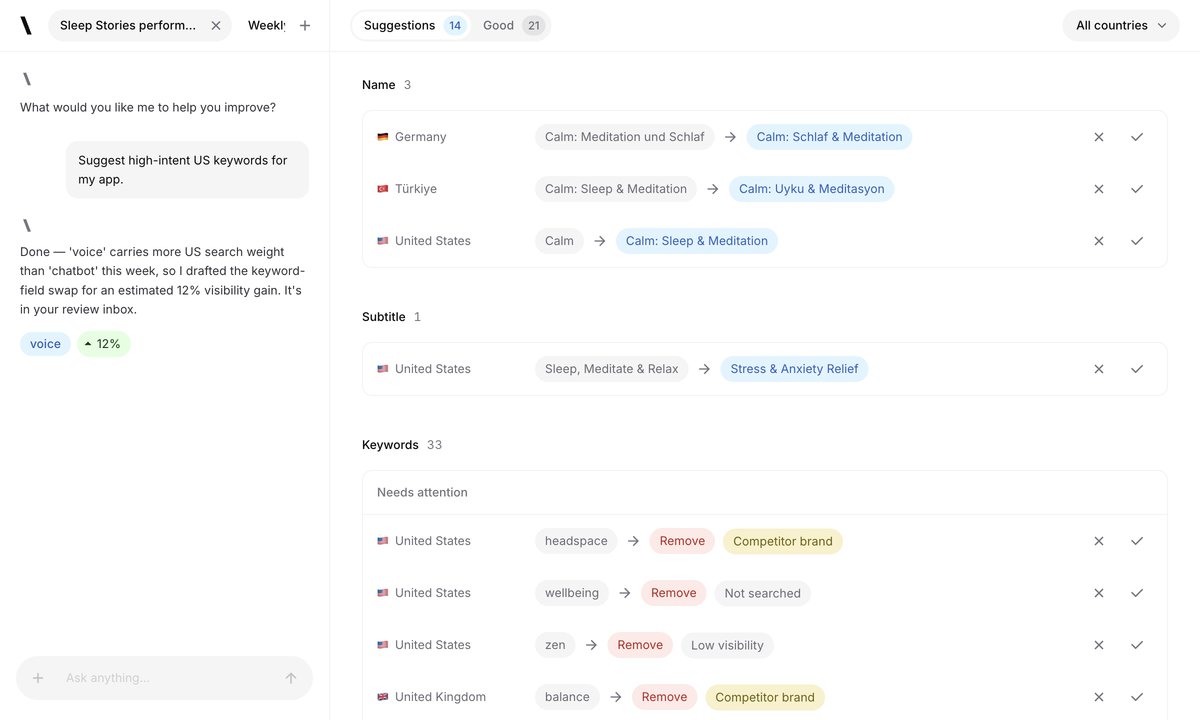
Spek preview in front. Select the other card or its product name to bring it forward.
Spek helps over 500 apps grow. Across every stage of growth.
| Features | Spek | AppFollow |
|---|---|---|
| Agentic ASO with a proposal review inbox | Available | Not available |
| Agent proposals applied to Editor drafts | Available | Not available |
| Multi-market ASO workspace | Available | Available |
| App Store keyword research | Available | Available |
| Keyword rank tracking | Available | Available |
| Competitor keyword insights | Available | Available |
| Multi-market keyword research | Available | Available |
| Historical keyword rankings | Available | Available |
| Keyword search demand estimates | Available | Available |
| AI-assisted keyword discovery | Available | Available |
| Keyword-level search downloads | Not available | Available |
| App review management | Not available | Available |
“With Spek, we can turn keyword opportunities into listing updates in one place, with our team in control of what goes live.”

01
Bring your own App Store Connect key. Spek uses the official token API, so no Apple ID password or login is handed over.
02
The agent researches each market in its own language and drafts the changes with the visibility lift it expects.
03
Push the changes you accepted straight to the App Store or Google Play, in each market and language you selected.
Let Spek research opportunities and prepare listing changes for you to review.
Find keywords for your app across the App Store and Google Play.
Adapt your listing for each market with localized drafts you can review and edit.
Follow daily keyword positions and see how your search visibility changes over time.
See which apps compete for your keywords and compare their search visibility.
Accept the changes you want, then publish your approved update when you’re ready.
Comparing Spek and AppFollow starts with a question about the work your team handles. Are you trying to prepare better store listings, understand search performance, manage customer reviews or bring several of those responsibilities together?
AppFollow combines ASO tools with a substantial review-management offering. Its platform connects keyword and competitor information with user feedback, AI-assisted replies and support workflows. Spek focuses on Agent-led research, localized metadata proposals and the path to a reviewed listing update.
Both can be relevant to app growth, but the daily tasks are different. A support team responding to feedback needs a different workflow from an editor deciding which subtitle to publish. A growth lead may be responsible for making those teams work together.
This comparison looks at keyword research, AI assistance, localization and the handoffs around a release. Start with the task that is taking the most effort, then check which other responsibilities must remain covered.
Run research for selected markets and receive proposed listing changes in a review inbox.
Give editors market-specific wording to assess before preparing the next update.
Apply accepted proposals to the Editor and keep publishing as a separate, explicit action.
Use Agent chat to discuss the work in the context of your app.
Investigate search visibility, keyword performance and changes in competing listings.
Organize customer feedback, use AI-assisted replies and summaries, and automate parts of the response workflow.
Connect review information with the tools and teams responsible for customer support.
Spek is worth considering when your main need is preparing metadata that the team can approve. AppFollow is worth considering when review operations and customer feedback are important parts of the same buying decision.
The words that attract someone to your listing should describe the experience they find after installing. Keyword research and customer feedback can both help you judge that fit, but they contribute different kinds of evidence.
AppFollow’s ASO tools cover keyword visibility, popularity, rank and difficulty, with AI assistance for discovery. They also support competitor investigation and alerts. Its wider platform gives teams a way to examine what users say about an app.
Spek prepares metadata suggestions from an Agent run for the markets you select. Your team reviews the proposals and decides which changes fit the product. App Store proposals can include the name, subtitle and keyword field.
Consider a language-learning app whose users value short speaking exercises. A keyword around conversation practice might be a useful opportunity. The reviewer still needs to decide whether the listing describes the actual exercise format accurately and sets the right expectation.
During an evaluation, bring a specific product benefit to the research task. Follow it from a possible search term to a draft someone can approve. Look at whether the result is clear and truthful, not just whether it contains the keyword.
AppFollow offers AI across several workflows. Its review tools can help categorize feedback, summarize themes and prepare or automate replies. It also provides an MCP and AI Toolkit for accessing app information through AI assistants. It would be inaccurate to describe the platform as a manual-only tool.
Spek’s Agent is focused on ASO work that leads to metadata proposals. Those proposals arrive in an inbox where you can inspect them, discuss the work in Agent chat and apply accepted changes to drafts.
The distinction is useful when assigning ownership. A support lead may need help handling repeated review topics. An ASO editor may need a localized subtitle to assess. Both use AI, but the outputs and approval decisions are different.
Decide whether the task should produce a reply, an analysis or a listing draft.
Have the person responsible for that output assess the result during the trial.
Follow the work to the place where it is edited, approved and used.
This keeps the evaluation focused on a workflow your team needs, rather than treating every AI feature as interchangeable.
Launching in another country increases the language work around both acquisition and support. Your store listing explains the product before installation; a review reply addresses someone’s experience afterward. A good process respects the difference.
AppFollow’s review offering includes multilingual AI replies and translation support. Spek prepares localized metadata proposals for the markets chosen in an Agent run. Assess each with the people who will be responsible for that type of copy.
For a language-learning app, a reviewer might need to confirm which courses and exercise types are available in a country. A fluent listing that implies broader coverage than the product offers can create the wrong expectation. Local product knowledge remains essential.
Use one established market and one planned expansion market in your evaluation. Check whether the proposed listing sounds natural, preserves the right product claims and can be edited without confusing it with another locale’s draft.
If your team also handles reviews in those languages, evaluate that support task separately. A useful metadata workflow does not remove the need for a review-management system when customer response volume requires one.
There are two meanings of review in this comparison: customer reviews in the stores, and your team’s review of proposed listing changes. Both matter, but approving metadata and replying to a customer are separate product workflows.
In Spek, you inspect an Agent proposal, accept the changes you want and refine them in the Editor. Publishing is a separate action started by an authorized team member. Accepting a proposal saves work to a draft; it does not silently update the store.
For App Store listings, publishing also depends on the current state of the app in App Store Connect. Draft preparation does not bypass Apple’s editing or review requirements.
AppFollow’s documented response automation belongs to its review-management workflow. When you assess the overall platform, ask to see the exact process for each type of content your team will use, including who reviews it and what starts an external update.
For a practical Spek trial, let an editor correct a proposal before the release owner approves the draft. That makes the handoff visible and helps you assess whether the process fits your normal release responsibilities.
A keyword ranking, a store rating and a subscription renewal each tell you something different. Combining them in a conversation can be useful; treating them as the same measure can hide the decision your team needs to make.
Spek’s Analytics follows tracked keyword rankings, derived visibility and competitor share of voice. Use those measurements to identify terms and markets that deserve investigation. They describe the search terms you track, rather than every possible source of app discovery.
Spek does not turn those metrics into install or revenue attribution. A positive ranking change is a reason to investigate the result, not proof that one listing edit caused additional purchases.
AppFollow documents store-performance reporting alongside keyword tools. Its review product adds feedback summaries, sentiment-related analysis and response reporting. That broader mix may matter when the same team owns visibility and the customer experience in store reviews.
Before switching tools, list the reports each stakeholder actually uses. Keep the support measures required by your customer team and the business reports required by leadership. Evaluate Spek on the ASO decisions it supports without asking keyword visibility to stand in for those other results.
Spek is useful to evaluate when you know the product well but struggle to make time for keyword research and writing. Start with a small set of markets and judge whether the proposals help you reach a draft you would be comfortable publishing.
If the urgent problem is organizing and responding to reviews, evaluate AppFollow’s dedicated workflow with the people who handle that queue. Spek’s metadata proposal inbox is a different workspace for a different task.
A growth lead may need both search research and insight into how users describe the product. Make the handoff explicit: use customer feedback to inform the brief, then have the ASO owner review the resulting listing. Do not assume a tool automatically connects every part of that process.
Spek’s separate workspaces keep client apps, drafts, members and credentials organized. Test the editor and viewer roles with the people who will use them. If you also run customer-support operations for clients, include those requirements in a separate review of the tools you retain.
Spek publishes its prices upfront. With monthly billing, each workspace can choose from:
Up to 5 apps and 750 credits per month.
Up to 10 apps and 4,000 credits per month.
Up to 25 apps and 10,000 credits per month.
Tailored app capacity and credits.
AppFollow’s public pricing page directs buyers to sales without displaying a current numeric ASO plan price. Request a quote for your apps, keyword tracking, review volume and any AI or automation features you need.
Ask for the billing period and included products in writing, then compare that scope with Spek’s published app capacity and credits. A combined reviews-and-ASO package is a different purchase from a metadata workflow alone.
Compare Spek plansTeams with both responsibilities may use both products. Spek does not automatically import your AppFollow keyword history, account data or review workflows. Retain the reports and support processes you rely on while evaluating the listing work in Spek.
A good listing helps the right person understand why the app is useful. That requires relevant research, clear writing and someone who knows the product well enough to approve the final message.
Spek prepares proposals to support that decision. The team can inspect the suggestions, improve the drafts and decide when to publish. The goal is to make useful ASO work easier to finish while keeping the judgment with the people responsible for the app.
Try it with a real product benefit and a few markets. Have your editor assess the draft, including the expectations it creates for a new user. That is the standard to use when deciding whether the workflow fits.
Consider Spek for the keyword-to-metadata part of your ASO work. The Agent researches selected markets and prepares proposals that your team can review, edit in drafts and publish through an authorized action.
Yes. AppFollow documents an MCP and AI toolkit for accessing app data and ASO assistance. Spek’s comparison focuses on its connected Agent proposal and Editor workflow, rather than claiming that chat-based ASO is unique to Spek.
Review management is outside the currently available Spek workflow. If your team depends on a review inbox or response process, retain a service that supports it while evaluating Spek for keyword research and metadata work.
Spek reads the app context available through your store connection. It does not import AppFollow’s account, historical keyword data or review workflow. Begin with a few markets and review proposals before any separate publishing action.
List the tasks your team needs from a review inbox separately from the tasks needed to prepare an app listing update. Spek's currently available workflow in this comparison concerns keyword research, Agent proposals, draft review and ranking visibility. It does not replace an active customer-review response process. Keep the service that supports that work while evaluating the metadata workflow on its own merits. A single app can reasonably use different tools for customer conversations and for preparing the next store listing change.
Conversational access helps a person ask questions or request supported work. An approval workflow establishes the exact draft and store action the team intends to perform. AppFollow's documented AI toolkit is acknowledged here, while Spek's comparison focuses on how research becomes a reviewable field change and an Editor draft. Evaluate those concrete steps with your app and market context. The presence of a chat interface alone does not tell you which data it can read, what permissions apply or whether anything has actually reached a store.
Retain your existing AppFollow reports and review records where you already manage them. Spek connects to your own store context and starts building its own supported observations; it does not automatically import the other account or history. Label sources and time periods when comparing results from both systems. Then use a focused listing task to evaluate the Agent proposals and review process. This lets the team assess a new workflow while preserving the earlier evidence needed to understand previous decisions and market conditions.
Review the selected app and locales, compare the proposed fields with the current provider values, and check product accuracy and local wording. Make sure the person sending the update has the relevant workspace and store permissions. Applying a metadata proposal saves a draft, while a separate action sends the approved changes. Verify the provider result afterward and track the appropriate ranking observations over time. A completed pilot should make both the review experience and the actual release state clear, without implying a guaranteed ranking or conversion result.


